
Does this sound familiar? Writing time starts, and half your class grabs crayons. Twenty minutes later—beautiful artwork, zero words. Frustrating, right?
Guess what? I stopped fighting the drawing and leaned into it. Turns out, drawing isn’t sabotaging writing time it’s your secret weapon.
Why Drawing First Works
Here’s the deal when students draw before writing, they generate ideas, organize thoughts visually, and include more details. Research shows that students who draw first write more complex sentences than those who write without drawing.
The key? Stop asking kids to “write cold.” Drawing provides a visual roadmap that makes writing easier and less frustrating.
5 Simple Steps to Transition from Drawing to Paragraphs
Step 1: Teach the “Magic Line”
Draw a horizontal line across the page to create ground and background. This simple trick helps students overcome blank-page fear and naturally adds setting details to their drawings.
Step 2: Add Labels
Start with single words labeling objects in drawings (dog, tree, mom). Model stretching out sounds: “Doooogggg. I hear /d/.” Then progress to phrases like “big dog” or “my dog.”
Step 3: Build Sentences
Teach the “Say it, Draw lines, Listen for sounds” method (Sound Mapping)
- Say the sentence: “My dog is big”
- Draw a line for each word (4 lines)
- Write letters for sounds you hear
- Read it back!
Use sentence frames like “I see _____” or “I like _____ because _____” to build confidence.
Step 4: Expand to Paragraphs
Teach students to “tell more.” After one sentence, ask: “What else can you say?” Introduce simple structure:
- Opening: “I went to the zoo”
- Details: “I saw lions. The monkeys were swinging”
- Closing: “It was fun!”
Step 5: Use Themed or Seasonal Prompts
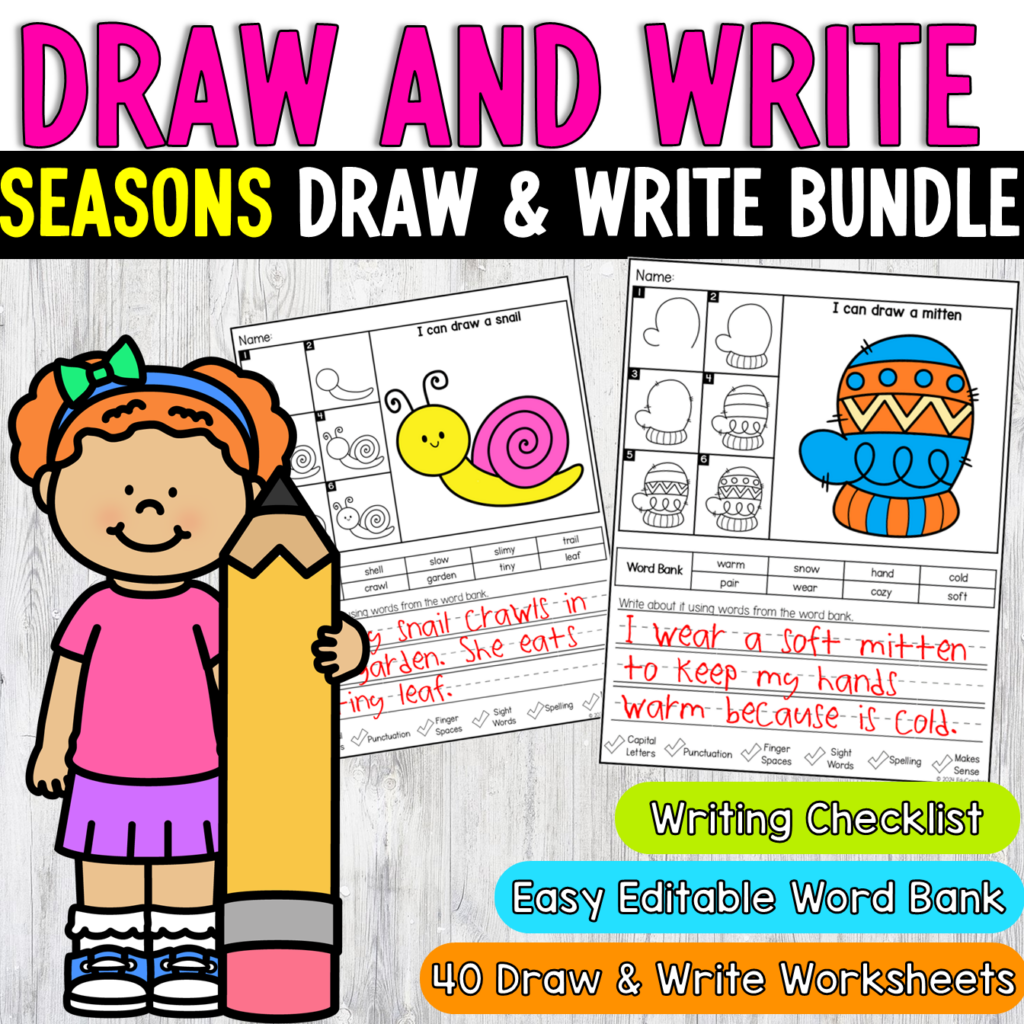
A way to keep students engaged is by using exciting topics! Seasonal writing practice work perfectly because kids can draw from real experiences. These Draw and Write Sentence Writing Prompts provide year-round topics (fall leaves, winter snowmen, spring flowers and more!) with drawing spaces, an editable word bank and checklist.
Try these Classroom Strategies
Make Drawing Non-Negotiable: Drawing should ALWAYS come first. It’s not a reward—it’s essential! Allow 5-10 minutes for drawing, then transition to writing.
Model Your Process: Think aloud as you draw and write. Show mistakes and how you fix them. Students need to see YOU use drawing to plan!
Conference with Students: Ask about their drawings. Even quiet kids will talk about their pictures, leading naturally to more writing.
Set Clear Expectations: From day one, establish the routine: “Draw first, then write.” Use a timer to keep them moving through both steps.
Quick Differentiation Tips
- Struggling writers: Accept labels or single words; provide sentence stems
- Advanced writers: Challenge them with multiple sentences and descriptive words
- English learners: Drawing = universal language; celebrate bilingual labels!
- Fine motor challenges: Focus on ideas, not perfect drawings
The Bottom Line
Drawing and writing aren’t competitors—they’re partners! When we let drawing be the the first step and teach students to add words to their pictures, we create confident writers. Research proves it: this approach produces more complex, detailed writing while making the process developmentally appropriate and fun.
So next time a student grabs crayons during writing time, smile and say: “Perfect! Draw your picture first, then we’ll add the words together!”
Save this post! What’s worked for you with drawing-to-writing? Share below!