
You know the moment: a first grader is mid-sentence in their writing journal, pencil hovering, and then the question comes.
“Teacher, how do I spell… the?”
They can sound out “cat” and “dog” all day. But “the”? “was”? “said”? Those little words show up everywhere, and phonics alone will not save us.
That is why knowing how to teach sight words well is one of the most useful tools in a K-1 teacher’s toolbox.
The good news? You do not need a fancy program. A simple routine plus a few low-prep activities is enough to get those words to stick.
What Are Sight Words, Anyway?
Sight words (also called high-frequency words) are the words that show up most often in the books our students read and write. Think “the,” “and,” “is,” “was,” “you.” Open any kindergarten reader and a huge chunk of the page is sight words.
Many teachers use Fry sight words or Dolch lists. The Fry first 100 words cover more than half of the words in most children’s books. That is a big deal for early readers.
Here is the part that surprises people: most sight words are actually decodable. “And” follows the rules. “It” follows the rules. So we are not just drilling random words.
The words that truly need memorizing are the ones that break the rules, or the ones whose tricky parts you cannot sound out yet. Those are the words we learn “by heart.”
Why Some Words Must Be Learned by Heart
The word “said” should, by the rules, sound like “sayed.” It does not. The word “was” looks like it should rhyme with “gas.” It does not.
For a five-year-old, trying to sound those out is a dead end. That is where heart-word thinking comes in.
Here is the simple version: look at the word, find the parts that follow the rules, then put a heart over the part you just have to remember. For “said,” the “s” and “d” are regular. The “ai” is the heart part. Learn that part by heart, and the whole word clicks.
This is honest, kid-friendly phonics. No magic, no gimmick. Just showing students exactly what their brain needs to remember.
How to Teach Sight Words: Introduce, Practice, Review
You do not need a new curriculum. You need a rhythm. Here is a routine that fits right into your day:
- Introduce (5 minutes): Show one to three new words on cards. Say them, clap them, use them in a sentence. Point out the heart part.
- Practice (10 minutes): Give students a hands-on way to use the words. Build them with letter tiles, trace them, or play a quick game.
- Review (5 minutes): Revisit old words every single day. A quick bingo round or a word hunt beats a worksheet any day.
The secret is not the number of words. It is the repetition with a little fun mixed in. Five minutes of daily review beats one long drill session every time.
Fun, Low-Prep Sight Word Activities for Kindergarten and First Grade
Kids will not sit still for flashcards forever. (Well, some will. The rest need games.) The good news? The best activities cost almost nothing to prep.
Sight word crowns. Yes, crowns. Print a crown for each word, and students get to wear their learning all day. It is silly, it is cheap, and it works. Want ready-made templates? This set of sight word crowns covers the Fry first 100 words for kindergarten and first grade.
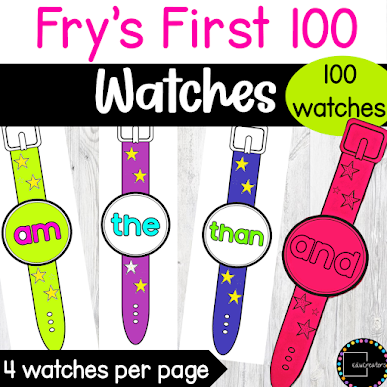
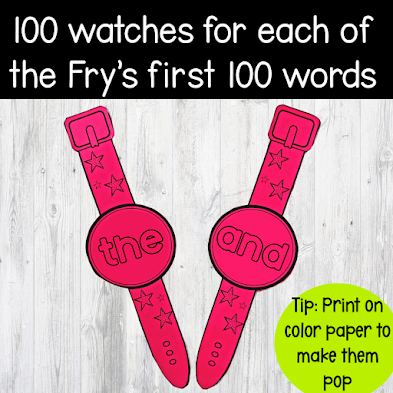
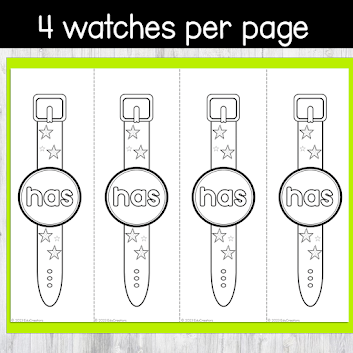
Sight word watches. Paper watches with a word on the face never get old. Students wear them and check the time all day. “What time is it?” “It is ‘has’ time!” Instant engagement, zero prep beyond printing.
Find and color. Give students a page full of words and one target word to hunt. They find every “the” and color it in. Perfect for morning work or a fast finisher bin.
Bingo. The classic sight word game, and it never misses. Print simple boards with the week’s words, call out a word, and watch students scan their boards. They are reading the whole time and think it is a party.
Word hunts. Send students looking for sight words in the books they are already reading, or around the classroom. Pointing at “the” on the calendar counts. It all counts.
And for a ready-made practice tool you can grab in one click, a simple set of sight word flashcards makes review time a breeze. Keep them in a pouch at your small-group table and you are always ready.
Plus, remember why we are doing all this: automatic word recognition is the foundation for building confident readers. When students stop stopping at every word, their fluency takes off.
How Heart-Word Thinking Helps
Here is why the heart-word approach beats plain memorization: it gives students a strategy instead of a list.
When a young reader meets an unknown word, they do not panic. They look at it. They sound out the parts they know. They check for a heart part. That is a skill they can use on any word, in any book, for the rest of their reading life.
It also keeps the learning honest. You are not telling kids “just memorize this.” You are showing them exactly which tiny piece of the word is the tricky part. That is respect for their brains, and it pays off.
Frequently Asked Questions
How many sight words should kindergarteners learn?
Most kindergarten teachers aim for 20 to 50 words during the year, depending on their school’s expectations. First graders typically add many more. Go slow, keep reviewing, and let each child set the pace. Depth beats speed.
What is the difference between Dolch and Fry sight words?
Both are lists of high-frequency words, just built differently. The Dolch list has 220 words and includes some common nouns. The Fry list has 1,000 words, and its first 100 cover the most common words in English text. Either list works; pick one and stay consistent.
How do I help a student who still cannot remember a sight word?
Keep the word in front of them in a low-stakes way: on a card at their desk, in a pocket chart, or on a ring of words they flip through. Point out the heart part again and use the word constantly in your own speech. Memorization needs repetition, not pressure.
A Warm Close
Here is the honest truth: sight word practice does not have to be a battle. A few minutes a day, a little repetition, and one good activity are all it takes to turn “the” and “was” from stumbling blocks into automatic wins.
Pick one activity from this post and try it tomorrow. Your students will have fun, and you will get to watch their reading confidence grow.
Happy sight word teaching!
-Vanessa